A latex-based dust suppressant polymer contains microscopic polymer particles dispersed in water. During application, the liquid carries those particles into the loose surface of a stockpile. As the water evaporates, the polymer binds neighbouring mineral grains and creates a cohesive crust.
The chemistry of the formulation determines how well that process works. The liquid must wet the fines, deposit sufficient binder and allow the polymer to form a film under the prevailing conditions. Understanding these stages helps explain why two treatments can produce very different results on the same material.
What is a latex-based dust suppressant polymer?
A polymer is a substance made from long molecular chains containing repeating chemical units. The structure and composition of those chains determine the polymer’s flexibility, adhesion and resistance to water.
‘Latex’ describes the physical form of the material rather than a single chemical. In a synthetic latex emulsion, fine polymer particles are suspended in water rather than dissolved in it. Acrylic and vinyl-acetate copolymers are examples of polymer chemistries used in film-forming coatings. Other dust-suppression formulations can use water-soluble polymers, such as polyvinyl alcohol.
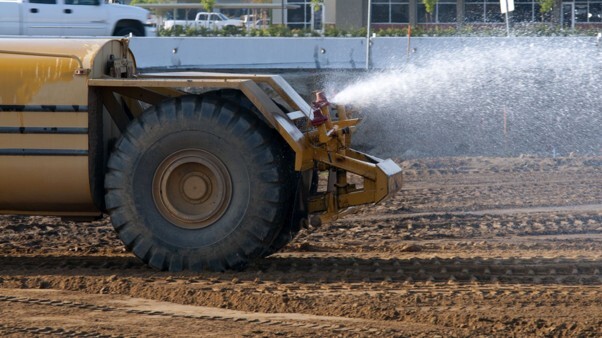
Our DustCrust 2000 is a concentrated latex polymer emulsion formulated for stockpile sealing. It is diluted with water and applied using a water truck, with the treatment penetrating the upper surface and binding particles into a hardened crust.
Why does wetting matter before the crust forms?
The liquid must reach the fine material it is intended to bind. A stockpile contains spaces or interstices between particles, and the ease with which liquid can enter those spaces depends on the surface chemistry, particle-size distribution and the formulation’s properties.
The formulation and application method influence how much binder reaches the surface layer and remains there:
-
Surface tension: Surfactants can help penetration by lowering the surface tension of the liquid, thereby improving its ability to spread across mineral grains and penetrate the spaces between them. Surfactants are one example of additives used in dust-suppression formulations; their inclusion and performance depend on the specific product.
-
Viscosity: Viscosity describes how readily a liquid flows. A low-viscosity treatment may spread and penetrate easily, but on a sloping or highly permeable stockpile it can also drain away before enough binder has been deposited near the surface. A thicker formulation may remain closer to where it is applied, although excessive viscosity can make it harder to distribute evenly or reach the fines beneath the surface. The formulation therefore needs to provide enough flow for the liquid to wet and enter the material, while retaining sufficient binder in the layer that will form the crust.
-
Concentration: The amount of polymer left in that layer depends on both the concentrate and the way it is applied. The concentrate’s polymer solids content indicates how much polymer is present before dilution. Adding water reduces the concentration in the working solution, but it does not change the total amount of polymer in the concentrate used. For example, a more dilute solution may require a greater application volume to deliver the same quantity of binder to a given area.
-
Application rate: Application rate determines how much working solution is delivered per square metre, while penetration and drainage influence how much of its polymer remains in the intended surface layer. If too little binder is deposited, the particles may be wetted without forming a sufficiently strong crust once the water evaporates. Uneven application can also leave weak patches alongside areas receiving more treatment than necessary.
What gives the finished crust its strength?
The polymer connects adjacent mineral grains, increasing the cohesion of the treated surface. This makes it harder for wind to detach individual particles and carry them away. The strength of the crust depends on the amount of binder deposited, how effectively it adheres to the mineral and the mechanical properties of the film formed as the treatment cures.
A durable crust also needs enough flexibility to accommodate small movements and changes in temperature or moisture. If the coating is too brittle, these stresses may cause it to crack and expose loose material beneath. Its resistance to water is equally important: rainfall can soften some polymer films or weaken their adhesion to the mineral, reducing the cohesion of the treated layer. The formulation therefore needs to balance strength, flexibility and water resistance for the conditions in which the stockpile will be stored.
Explore DustCrust 2000
DustCrust 2000 is intended for materials including coal, iron ore and ash, as well as earthworks and unmade ground. To discuss whether DustCrust 2000 is suitable for your materials and site, contact our team.




No Comments Yet
Let us know what you think